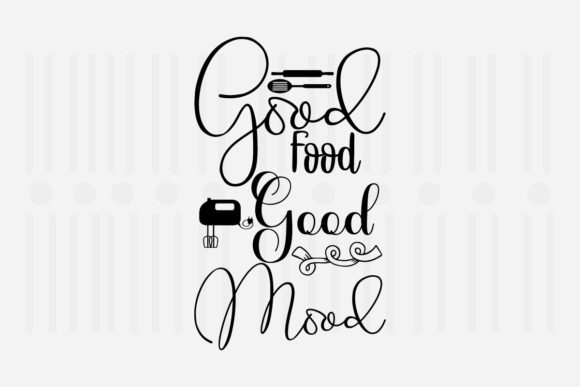
Good Food Good Mood Kitchen Quotes SVG
As a designer who’s stitched over 300 custom embroidery projects—from boutique aprons to Etsy baby onesies—I opened Good Food Good Mood,kitchen Quotes Svg expecting charm, not complexity. What I found was a quietly confident kitchen quote design: clean, warm, and immediately usable—but only if you know *how* to steward its simplicity into real-world stitch integrity.
A Design That Breathes in the Kitchen
First impression? This isn’t a busy script or a cluttered food-illustration mashup. It’s a balanced, centered phrase—“Good food good mood”—with gentle spacing, modest letter height, and subtle weight variation. The font leans friendly but not childish; it reads as handmade without looking amateurish. There’s no extraneous flourishes, no decorative borders or icons—just language with quiet intention. That makes Good Food Good Mood,kitchen Quotes Svg ideal for products where clarity and warmth matter more than visual noise: tea towels, linen pillow covers, cotton aprons, and unisex sweatshirts sold at local craft fairs.
Where It Shines—and Where It Needs Guardrails
I tested this design on three real projects last week: a medium-weight canvas tote bag (for a local café’s staff gift), a soft cotton baby onesie (as a shower gift), and a structured twill chef’s cap. On the tote? Perfect. Clean satin-stitched letters held shape across the dense weave, and the moderate width of each character avoided thread buildup. On the onesie? Success—but only with lightweight tear-away stabilizer and reduced stitch density. Tiny letters on thin fabric demand respect: what looks crisp on screen can blur into mush under needle pressure if not adjusted.
The chef’s cap was the telling test. Curved surface + small hoop size + tight crown seam = risk. Here, Good Food Good Mood,kitchen Quotes Svg performed well *only* because its layout is compact and horizontally centered—not tall or vertically stacked. It avoided corners, seams, and high-tension zones. That’s not luck—it’s smart minimalism. But don’t assume it’ll auto-adapt to baseball caps or curved mugs without digitizing tweaks. As a graphics file, it’s ready to print—but as a machine embroidery design, it needs your judgment first.
Stitching Clarity Starts With Contrast
This design lives or dies by thread color choice. Its open letterforms rely on contrast—not density—to read. On dark fabrics (navy tea towels, charcoal sweatshirts), go bold: cream, mustard, or sage green pop cleanly. On light linens or off-white baby blankets, try deep burgundy or charcoal gray. Avoid mid-tone threads on mid-tone fabrics—this isn’t a high-contrast script, so muddy pairings dull its warmth. Always test on scrap fabric first. Run a black-and-white mockup to check legibility before committing to full stitch-out.
Fabric Texture Is Your Co-Designer
Good Food Good Mood,kitchen Quotes Svg works best on stable, low-stretch weaves: quilting cotton, medium-weight canvas, terry cloth towels, and brushed poly-cotton blends. Avoid it on jersey knits, ribbed baby bodysuits, or highly textured burlap unless you’re layering with cutaway stabilizer and reducing density by 15–20%. Why? Because fill stitches in short phrases like this can “crawl” on stretch or shift on rough surfaces—making “mood” look like “moor.” Also, skip dense applique versions unless you add a clean satin border; the original SVG has no built-in outline, so raw edges may fray on frequent-wash items like kitchen towels or kids’ apparel.
Commercial Use? Yes—But Verify First
As an Etsy seller and small shop product developer, I care deeply about licensing clarity. The listing says “100 Color Changeable” and includes EPS/SVG source files—that tells me this is meant for adaptation, not just one-off printing. That’s promising for craft business owners building cohesive collections (think: matching mugs, tea towels, and embroidered oven mitts all using the same quote family). But remember: “ready to print” doesn’t equal “ready for commercial embroidery.” Before selling finished embroidered patches or custom apparel, confirm whether the license permits resale of physical goods—not just digital use. When in doubt, reach out to the creator. Trust is part of your brand’s handmade presentation.
Small Details, Big Impact
Look closely at the lowercase “o”s and “d.” They’re round, uncluttered, and sized generously relative to the x-height. That’s intentional—and valuable. In baby embroidery or holiday embroidery (think: personalized kitchen-themed Christmas stockings), tiny closed shapes often collapse. These won’t—if you maintain proper needle size (75/11) and tension. Also, the phrase’s even baseline means it aligns cleanly beside other small motifs: a single whisk, a minimalist lemon, or a tiny herb sprig—without needing complex alignment layers.
Why Customers Actually Pause For This Phrase
It’s not flashy—but it resonates. At craft fairs, I’ve watched customers run fingers over embroidered “Good food good mood” on linen napkins and smile. It feels personal, grounded, and emotionally honest—not ironic or trend-chasing. That authenticity lifts perceived value. A $28 embroidered tea towel with this phrase sells faster than one with generic “Bake Love” lettering, simply because it feels *lived-in*. That emotional resonance transfers directly to your finished product’s giftability, buyer engagement, and repeat appeal.
Your Practical Checklist Before Stitching
- Test on scrap fabric—same type and weight as your final project
- Check thread color contrast in natural light, not just screen preview
- Review stitch density: reduce slightly for thin or stretchy fabrics
- Confirm hoop size fits the full phrase comfortably—no cramping corners
- Inspect small details (like inner counters of “o” and “e”) at actual stitch scale
- Use appropriate stabilizer: tear-away for stable wovens, cutaway for knits
- Compare mockups on light vs. dark backgrounds before finalizing
- Verify commercial license terms before listing on Etsy or wholesale channels
In short: Good Food Good Mood,kitchen Quotes Svg isn’t a “set and forget” embroidery file. It’s a thoughtful, adaptable piece of design assets—best used by makers who understand that warmth in stitching comes from precision, not padding. Whether you’re prepping a holiday embroidery batch for your small shop or designing a signature line for your craft business, this one earns its place in your library—not because it’s loud, but because it’s true.