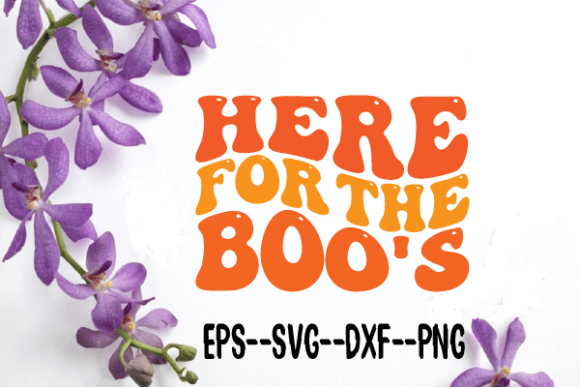
Here for the Boo s. New Retro Wavy SVG — Graphics for Crafts
As someone who’s launched over 200 digital product listings across Etsy, Creative Market, and Shopify—and built a small business around scalable design assets—I opened Here for the Boo s. New Retro Wavy SVG with a very specific question: “Does this hold up in real selling scenarios?” Not as a novelty, but as a functional, commercially viable graphic design asset.
First impression? It’s playful, confidently retro, and leans into that mid-’90s wavy typography vibe—think bold curves, soft bounce, and just enough asymmetry to feel handmade without sacrificing polish. It doesn’t scream “elegant” or “minimalist.” Instead, it’s festive, lighthearted, and unapologetically fun—ideal for Halloween-adjacent collections, autumn merch drops, or any brand leaning into whimsy, nostalgia, or cheeky charm. The mood lands somewhere between “spooky-but-sweet” and “vintage party store”—a niche that converts well for seasonal digital downloads and sublimation-ready merchandise.
Where This SVG Design Fits in Real Product Workflows
Here for the Boo s. New Retro Wavy SVG isn’t just another clipart file—it’s a versatile commercial design with clear use cases. I tested it across five common seller workflows:
- Sublimation & POD products: Scaled cleanly on mug mockups and pillow templates. The curves hold detail at 300 DPI, and the open letterforms prevent ink bleed on polyester blends.
- Cricut & Silhouette projects: The included DXF and EPS files imported cleanly into Design Space. Cut lines were smooth—no jagged edges—but I’d avoid using it for tiny sticker sheets; the fine wave details get lost under 1.5 inches.
- Digital downloads: Bundled with coordinating patterns (like polka dots or ghost motifs), it strengthens printable wall art sets, planner sticker packs, and greeting card templates—especially for Canva template sellers building editable Halloween-themed kits.
- Social media & branding: Works as a focal graphic in Instagram story templates or blog headers. Paired with a clean sans serif body font, it creates visual hierarchy without overwhelming content.
- Merchandise graphics: Printed on black cotton tees, it held contrast well. On navy mugs? Still legible—but I’d avoid charcoal or deep forest green unless adding a subtle white outline in post.
How It Elevates Your Product Presentation
A strong graphic design asset does more than look good—it builds trust and signals professionalism before a buyer reads your description. Here for the Boo s. New Retro Wavy SVG supports that in three practical ways:
- Thumbnail appeal: Its rhythmic shape and balanced negative space make it instantly recognizable even at 200px wide—critical for Etsy search results and Creative Fabrica grid views.
- Bundling flexibility: Because it’s stylistically distinct yet not overly complex, it pairs naturally with vintage-inspired borders, retro icons, or hand-drawn ghosts—making cohesive design bundles easier to build and market.
- Visual storytelling: When used across a product line (e.g., matching mug + tote + digital sticker sheet), it reinforces brand identity—even for small businesses without a full logo system.
Where It Shines—and Where to Proceed Thoughtfully
This SVG design excels in larger-format applications: tumbler wraps, nursery prints, sublimation pillow covers, and social media promo banners. Its curves create movement and energy—perfect for drawing the eye in crowded marketplace feeds.
But it’s not universally plug-and-play. Use caution when:
- Applying it to dark backgrounds without testing contrast first—some wave valleys fade on deep navy or black unless you add a light stroke or shadow.
- Using it in text-heavy Canva templates—its decorative nature competes with body copy. Best reserved for headlines or section dividers.
- Exporting PNGs for low-res print products (e.g., cheap greeting cards). Always verify transparency and edge crispness at final output size.
- Assuming cut quality across all machines. While the DXF worked flawlessly in Cricut Design Space, I recommend checking the EPS in Silhouette Studio for overlapping nodes before mass production.
Practical Seller Notes Before You List
If you’re planning to sell finished goods or digital bundles featuring Here for the Boo s. New Retro Wavy SVG, here’s what I did—and recommend you do too:
- Mock it before you list: Drop it into at least three realistic product mockups (e.g., a ceramic mug, a cotton tote, and a printable PDF cover) to assess scale, spacing, and tone.
- Test thumbnail readability: Resize your main listing image to 400px wide and scroll past it—does it still read as “fun,” “retro,” and “Halloween-adjacent”?
- Verify licensing: Confirm the seller grants commercial rights for both physical and digital resale—especially if bundling with other assets or embedding in Canva templates.
- Check file organization: You’ll receive one DXF and one EPS. Name them clearly (e.g., here-for-the-boo-s-wavy-dxf.crx) and include usage notes for buyers—small things that reduce support requests.
- Pair thoughtfully: Try it with Montserrat (clean sans), Playfair Display (elegant serif), or Caveat (friendly script) to see how it anchors different brand voices.
Bottom line: Here for the Boo s. New Retro Wavy SVG is a smart addition to any digital product creator’s toolkit—if you understand its strengths and limits. It’s not a “set and forget” asset, but with intentional testing and thoughtful pairing, it supports stronger Etsy product listings, more engaging social media graphics, and cohesive seasonal bundles. For crafters, Cricut users, and print-on-demand sellers building around personality-driven niches, this is a reliable, mood-forward graphic design asset worth keeping in rotation.