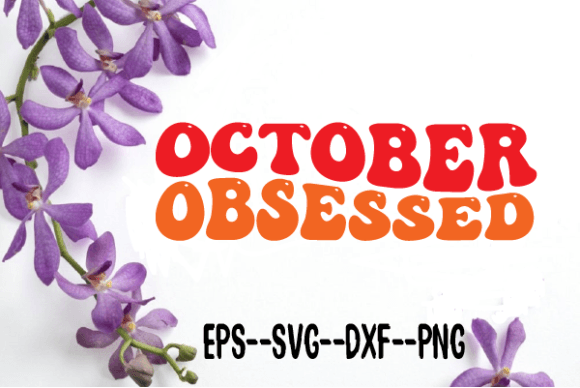
October Obsessed Retro Wavy SVG: Graphics for Crafts-Driven Branding
As a brand designer who’s helped over 70 local businesses refine their visual identity—from maple syrup bottlers in Vermont to ceramic studios in Portland—I opened October Obsessed Retro Wavy SVG expecting nostalgic charm. What I found was more nuanced: a confident, rhythm-driven vector motif that pulses with autumnal warmth without leaning into cliché pumpkins or falling leaves. It feels handmade but precise, playful yet intentional—like a hand-drawn wave reinterpreted through clean vector lines and subtle asymmetry. For small business branding, this isn’t just decoration; it’s a mood-setter. It suggests approachability, seasonal authenticity, and tactile creativity—ideal for food brands with artisanal credibility, botanical skincare labels, candle makers, boutique gift shops, or children’s product lines launching a fall collection.
A Versatile Graphic Design Asset for Real Local Business Touchpoints
This SVG works where local businesses need instant visual cohesion: on product labels, packaging accents, and social media graphics. Imagine it wrapping the base of a honey jar label—echoing the golden swirl inside—while anchoring the brand name above in a warm serif. Or scaling it as a repeating border on thank-you cards for a handmade soap business, reinforcing consistency across customer touchpoints. It’s equally effective as a hero graphic behind a café’s limited-edition pumpkin spice latte poster, or as a subtle watermark on printable menu inserts for a family-run pie shop. Because it arrives as both DXF and EPS files, it integrates cleanly into packaging design workflows—whether you’re prepping for digital die-cutting on kraft hang tags or exporting for foil-stamped boxes. As a printable design, it holds crispness at any size, making it reliable for both large-format window decals and 2-inch sticker sheets.
Where It Strengthens Small Business Branding—Practically
- Stronger first impression: On crowded shelves or Instagram feeds, its rhythmic motion draws the eye before text registers—critical for local boutiques competing with national retailers.
- Better product recognition: When repeated across mugs, tote bags, and candle jars, it becomes a signature visual cue—not unlike the wave motif used by heritage tea brands or coastal apothecaries.
- Clearer visual hierarchy: Its organic flow naturally frames headlines or product names, guiding attention without competing with core messaging.
- More consistent brand identity: Unlike one-off clipart, this vector asset scales, recolors, and repeats predictably—essential for cohesive marketing visuals across print and digital.
- Improved customer trust: Professionally rendered waves signal intentionality, helping handmade businesses avoid the “DIY-but-unpolished” perception.
Best Uses: Packaging Accents, Seasonal Campaigns & Social Proof
The October Obsessed Retro Wavy SVG shines brightest where personality matters most: product mockups for Etsy listings, decorative borders on seasonal packaging (think kraft boxes sealed with wax-stamped tape), hero banners for farmers’ market booths, and Instagram Story templates for holiday promotions. It adds texture to minimalist skincare labels without overwhelming ingredient lists. It softens the rigidity of rigid plastic packaging for children’s wooden toys. And because it’s built as scalable vector art—not raster clipart—it retains integrity when reversed out of dark backgrounds on coffee sleeves or embroidered onto linen napkins. For food businesses especially, it bridges the gap between “farm-fresh” authenticity and modern editorial design—something many local brands struggle to balance.
Use With Intention—Not Everywhere
This graphic design asset doesn’t belong everywhere. Avoid embedding it directly into legal disclaimers, nutrition panels, or tiny QR code labels—its fluid lines lose legibility under 8mm height. Don’t force it into tightly packed ingredient-heavy layouts for food labels; it competes with critical information instead of supporting it. Luxury minimalist brands (e.g., high-end ceramic tableware or monochrome candle lines) may find its energy too expressive—unless deliberately contrasted against stark typography. And never assume it works on low-contrast backgrounds: test it over your actual kraft paper stock or matte black mug finish before finalizing production files.
Brand Designer Notes You Can’t Skip
Before committing to October Obsessed Retro Wavy SVG for client work or your own product line, run these checks: First, drop it into a real packaging mockup—not just a white background preview. Does it hold weight beside your brand’s primary typeface? Test it next to serif, sans serif, script, and display fonts to see which pairing reinforces your voice (e.g., a bold condensed sans for a modern bakery vs. a delicate script for a floral studio). Print a sample on your intended substrate: Does the wave’s curve stay smooth on textured paper? Check black-and-white output—some retro wavy motifs collapse into muddy gray when converted, but this one retains definition. Confirm commercial licensing covers physical product sales, not just digital use—many creative marketplace assets restrict resale on merchandise unless explicitly stated. Finally, inspect the vector paths: Are anchor points clean? Can you easily isolate segments to create custom borders or corner flourishes? That editability separates usable design assets from decorative dead ends.
Why This Fits the Crafts Ecosystem—and Your Business
In today’s landscape, local business owners aren’t just selling products—they’re selling stories, seasonality, and sincerity. The October Obsessed Retro Wavy SVG supports that narrative without dictating it. It’s not prescriptive; it’s adaptable—equally at home on a lavender-scented soy candle label and a small-batch apple butter jar. As a graphics resource rooted in Crafts sensibility, it honors handmade values while delivering professional-grade flexibility. Whether you're designing for a weekend farmers’ market stall or building a full brand identity system, this SVG serves as both accent and anchor—proving that thoughtful, well-executed design assets remain essential infrastructure for small business branding, packaging design, and authentic marketing visuals.